FFIAM
Full-Field Irradiance Analysis Model
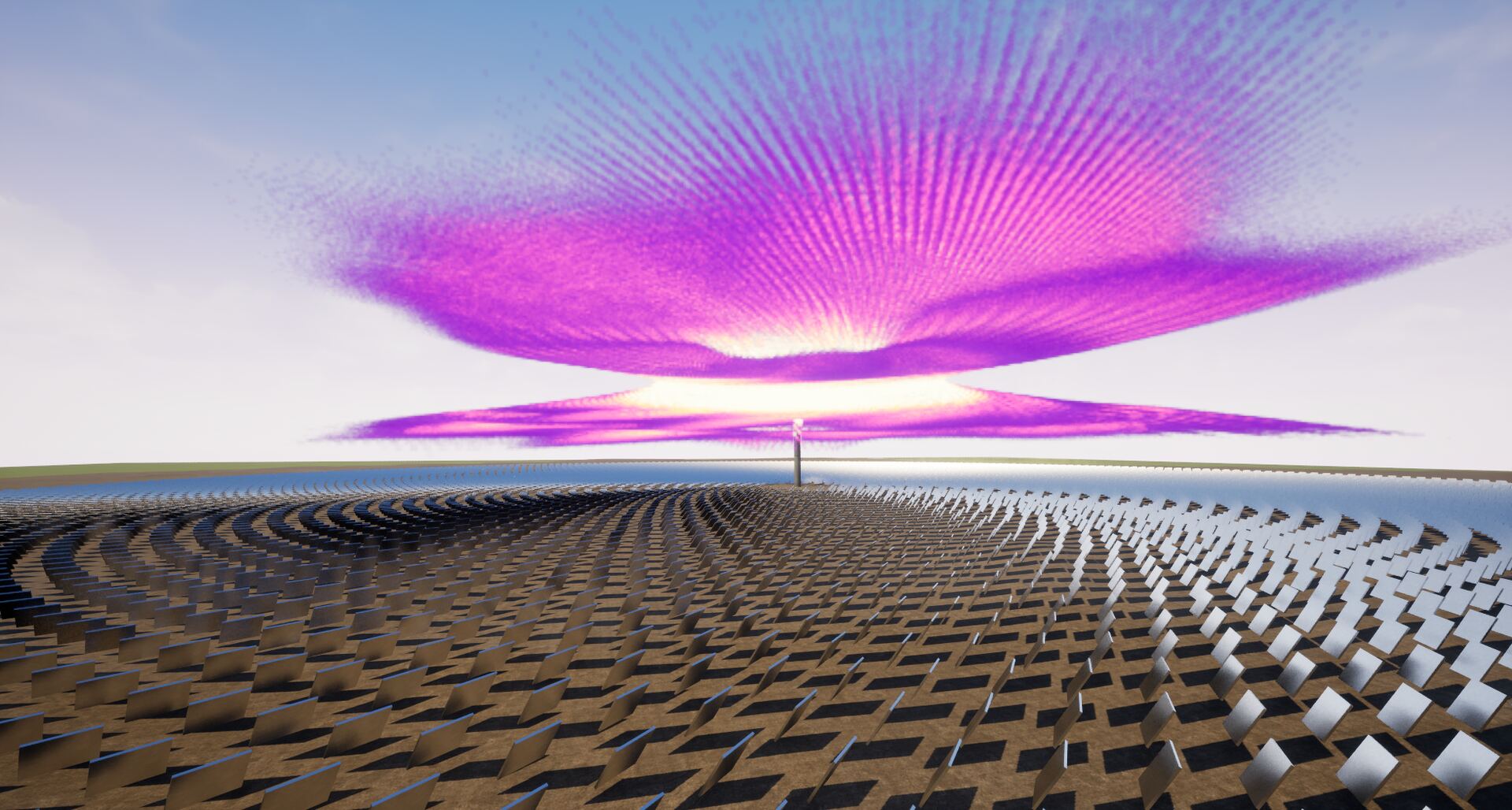
A concentrating solar power field in standby still reflects sunlight. That energy collects in the airspace above the field, where it's a hazard to aircraft and birds.
FFIAM shows where it collects, how intense it is, and how it moves with the sun and the aim strategy. It divides the airspace into a 3D grid of voxels and computes the irradiance in each one, tracing reflected sunlight facet by facet from every heliostat.
We built it for Sandia as a C++/CUDA library with a parallel CPU fallback, packaged in Docker with a one-command quickstart. On top are two workflows: a Python analysis module and a real-time Unreal Engine renderer. Every image on this page is FFIAM output.
Seeing the Airspace
Colored voxels mark reflected-sunlight irradiance above the reporting threshold. Brighter means more intense.
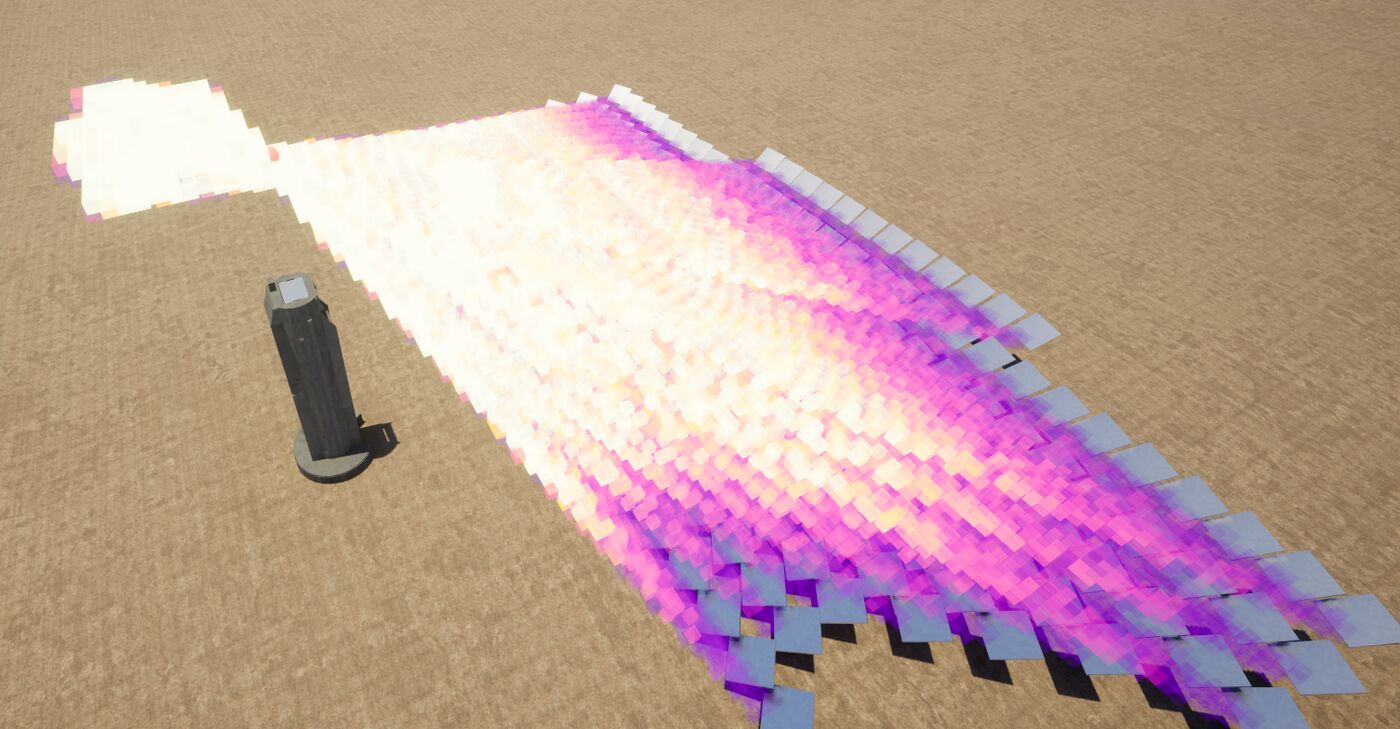
National Solar Thermal Test Facility
Standby irradiance at Sandia's NSTTF. The highest flux forms a plume above the receiver tower.
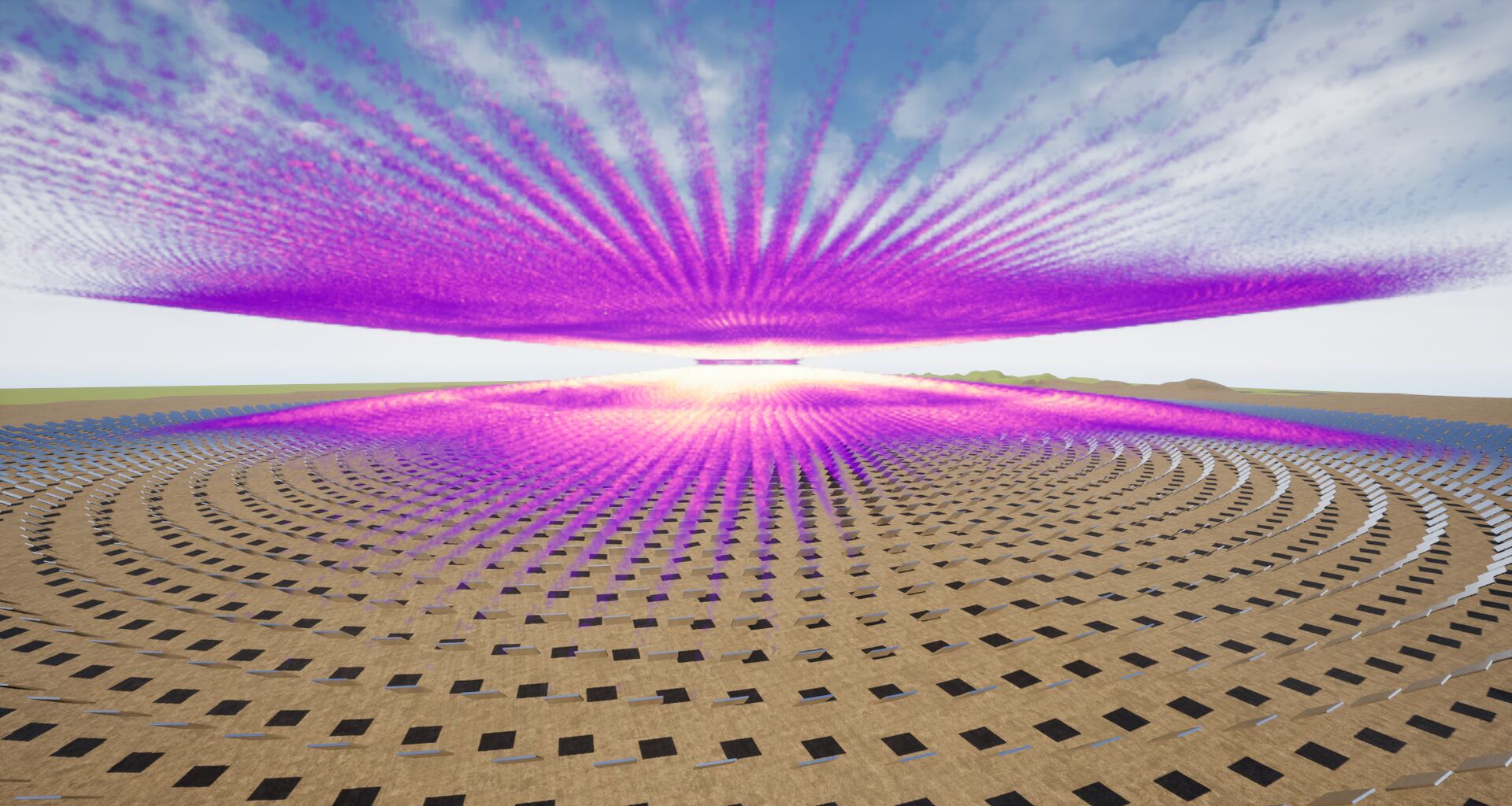
Single-point standby
Every heliostat aimed at one location. The reflected flux converges into a concentrated high-irradiance column.

300 million cubes
Each cube holds the computed irradiance at that point in the airspace. A full-scale V3.0 analysis evaluates about 300 million of them.
FFIAM V3.0
1.6 km
maximum field radius
300 m
airspace height
11,000+
heliostats
~300M
voxels at 2 m resolution
Smaller fields can run at 1 m resolution. FFIAM uses an NVIDIA GPU when there is one and a CPU backend with the same features when there isn't, so it runs on any machine with Docker.
Two Workflows
Data workflow
The pyffiam Python module, run from the command line or a script. It produces voxel-scatter heatmaps in each cardinal plane, time-resolved animations, flight-path irradiance and radiant-exposure plots, and an Excel summary ready for a report.
Visualization workflow
An interactive Unreal Engine scene rendering the field and its high-irradiance voxels, navigable in real time with adjustable site, date and time, aim strategy, and reporting threshold.
Validation
Results were checked against ray tracing and against UAS measurement campaigns flown at the National Solar Thermal Test Facility. The project ran for three years and concluded in June 2026 with the open-source release of FFIAM V3.0 through Sandia's OpenCSP ecosystem.
Released through Sandia OpenCSPNeed something like FFIAM?
We build the compute and the visualization. Tell us about your model.
Get in Touch